
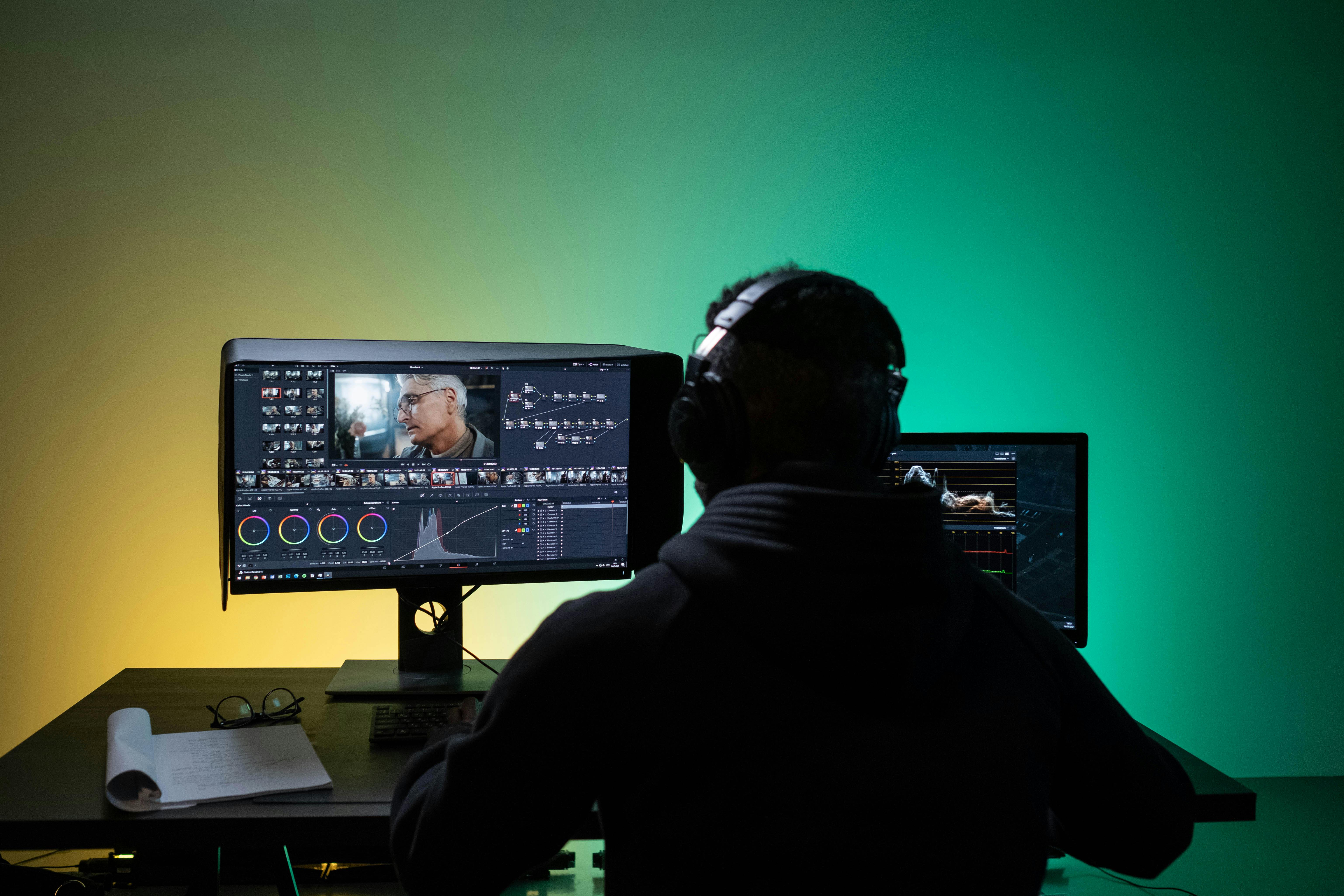
In 2026, Artificial Intelligence isn't just a buzzword – it's the game-changer for video editors. Discover how the latest AI video editing software and services are automating tedious tasks, enhancing creativity, and dramatically boosting efficiency, leading to unparalleled content quality and significant ROI. We compare the leading platforms to help you choose the best tools for your professional video production needs and maximize your earnings.
Introduction to the AI Video Editing Revolution
Welcome to 2026, where the video editing landscape has been irrevocably transformed by Artificial Intelligence. Gone are the days of laboriously sifting through hours of footage, manually rotoscoping complex subjects, or spending countless hours on repetitive tasks. Today, AI-powered video editing software and services are not just assisting editors; they are fundamentally reshaping workflows, unlocking unprecedented creative possibilities, and, most importantly for our readers at videostadium.com, significantly boosting productivity and profitability. This isn't about AI replacing human creativity, but rather about augmenting it, allowing professionals to focus on storytelling, artistic vision, and delivering higher-quality content faster than ever before. If you're looking to future-proof your skills, increase your output, and secure a competitive edge in the rapidly evolving content creation economy, understanding and integrating these cutting-edge AI tools is no longer optional – it's essential.
Backgrounds & Facts: The Evolution of Smart Editing
The journey of AI in video editing has accelerated exponentially since the early 2020s. What began as rudimentary automated transcription and basic object tracking has blossomed into sophisticated neural networks capable of understanding narrative, enhancing visual aesthetics, and even generating entirely new visual elements. By 2026, AI is seamlessly integrated across the entire post-production pipeline:
- Automated Rough Cuts: AI algorithms can now analyze scripts, audio cues, and visual events to generate surprisingly coherent first-pass edits, dramatically reducing the time spent on assembly.
- Generative Fill & Object Removal: Imagine effortlessly removing unwanted elements from a scene or extending backgrounds with AI that intelligently generates missing pixels, all with a few clicks. This technology is now standard.
- Advanced Color Grading & Correction: AI understands color theory, scene context, and even emotional tone to suggest and apply professional-grade color grades, ensuring consistency across diverse footage.
- Intelligent Audio Sweetening: From noise reduction and dialogue enhancement to automatic mixing and mastering, AI handles complex audio tasks with precision, freeing editors from laborious sound design.
- Smart Upscaling & Restoration: Legacy footage or low-resolution captures can be stunningly upscaled to 4K or even 8K, with AI intelligently adding detail and reducing artifacts.
- Dynamic Reformatting: AI automatically reframes and adapts content for different aspect ratios (e.g., horizontal to vertical for social media) while maintaining subject focus and composition.
Industry reports indicate that studios and freelance editors leveraging advanced AI tools are reporting up to a 50-70% reduction in post-production time for routine tasks, translating directly into higher project turnover and increased revenue. The market for AI-powered video editing solutions is projected to exceed $5 billion by 2027, underscoring its pivotal role in the future of media production.
Expert Opinion / Analysis: The Human-AI Partnership
Leading industry professionals agree: 2026 marks the era of the 'AI-augmented editor,' not the 'AI-replaced editor.' "AI takes the grunt work, allowing me to focus on the artistry," explains Maya Singh, a renowned editor for major streaming platforms. "I used to spend hours on rotoscoping complex VFX shots; now, AI does 90% of the heavy lifting in minutes. My creative output has exploded."
Dr. Alex Chen, a prominent AI researcher specializing in media, emphasizes the evolving role. "The human editor's expertise in narrative, emotional resonance, and ethical judgment remains paramount. AI is a powerful co-pilot, not a replacement. The best editors of tomorrow will be those who master the art of prompting AI, curating its outputs, and infusing their unique vision into the AI-generated elements."
However, challenges persist. Data privacy, the potential for 'deepfakes,' and the need for robust ethical guidelines are ongoing conversations. "It's crucial that editors understand the provenance of AI-generated content and maintain transparency," notes Chen. "The tools are powerful, and with great power comes the responsibility to use them ethically and creatively." The consensus is clear: invest in learning these tools, understand their limitations, and integrate them strategically to elevate your craft and market value.
💰 Best Options in Comparison: AI Video Editing Software & Services of 2026
Navigating the burgeoning market of AI video editing solutions can be daunting. We've meticulously evaluated the top contenders in 2026, focusing on features, ease of use, integration, and value for money, to help you make an informed decision and maximize your revenue potential.
- Adobe Sensei Pro Suite (2026 Edition): The industry standard continues to innovate. Adobe's Sensei AI is deeply integrated across Premiere Pro, After Effects, and Audition, offering unparalleled continuity. Key features include advanced Generative Fill for scene extension, automatic smart reframe for social media, AI-powered dialogue isolation, and intelligent object tracking with predictive analysis. It's best for professionals already embedded in the Adobe ecosystem seeking a comprehensive, all-in-one AI solution.
- DaVinci Resolve Neural Engine Max: Blackmagic Design's Resolve has always been a powerhouse for color grading and VFX, and its Neural Engine Max takes it to another level. Expect enhanced Magic Masking, AI-driven de-interlacing and upscaling, automatic facial refinement, and sophisticated scene cut detection. Its cloud collaboration features, powered by AI, make it ideal for high-end studio work and remote teams focused on cinematic quality.
- RunwayML Studio Pro (2026): A pioneer in generative AI for video, RunwayML Studio Pro is the go-to for cutting-edge text-to-video, image-to-video, and advanced inpainting/outpainting capabilities. If you're looking to create entirely new visual assets, animate still images, or extend existing footage with mind-bending AI creativity, this platform is unmatched. It's perfect for experimental filmmakers, motion graphic artists, and content creators pushing the boundaries of visual storytelling.
- Descript AI Pro (2026): While primarily known for its revolutionary transcription-based editing, Descript AI Pro has expanded its video capabilities significantly. Its AI allows for effortless 'overdub' (cloning voices to fix audio mistakes), automatic removal of filler words, and highly accurate multi-speaker identification. For editors working extensively with interviews, podcasts, or documentary content, Descript streamlines the entire editing process, making it as easy as editing a text document.
- CapCut Pro AI (2026): Evolving beyond its mobile-first origins, CapCut Pro AI has become a surprisingly powerful desktop and cloud-based editor, especially for short-form content. Its AI features include intelligent auto-captions, dynamic background removal, AI-driven stylistic filters, and swift content adaptation for various social platforms. It's an excellent, cost-effective choice for social media managers, vloggers, and marketers needing rapid, high-quality content generation.
Comparison Table: Top AI Video Editing Tools of 2026
| Tool Name | Key AI Features | Best For | Pricing Model | Unique Selling Proposition |
|---|---|---|---|---|
| Adobe Sensei Pro Suite | Generative Fill, Smart Reframe, Dialogue Isolation, Object Tracking | Integrated professional workflows, comprehensive suite users | Subscription (Creative Cloud) | Seamless ecosystem integration, broad feature set |
| DaVinci Resolve Neural Engine Max | Magic Masking, AI Upscaling, Facial Refinement, Scene Cut Detection | High-end color grading, VFX, collaborative studio productions | Perpetual License (Studio) | Unrivaled post-production depth, no subscription lock-in |
| RunwayML Studio Pro | Text-to-Video, Image-to-Video, Inpainting/Outpainting, AI Style Transfer | Generative content creation, experimental visuals, motion graphics | Tiered Subscription (Usage-based) | Pioneering generative AI, limitless creative possibilities |
| Descript AI Pro | Transcription-based editing, Overdub (voice cloning), Filler Word Removal | Interview content, podcasts, documentaries, rapid textual editing | Subscription (Tiered) | Edit video like a document, unparalleled audio workflow |
| CapCut Pro AI | Auto-captions, Dynamic Background Removal, AI Filters, Smart Reframe | Social media content, vloggers, rapid marketing videos | Subscription (Freemium model) | User-friendly interface, powerful AI for short-form content |
Ready to transform your workflow? Consider signing up for a free trial or exploring the professional plans for these leading AI video editing solutions. Many offer flexible subscription models tailored for individual creators and large studios alike. Investing in the right AI tool now will pay dividends in time saved and increased project capacity.
Outlook & Trends: The Future is Hyper-Intelligent
Looking ahead, the integration of AI into video editing will only deepen. We anticipate even more sophisticated AI co-pilots that can anticipate editorial decisions, suggest alternative cuts based on audience engagement data, and even generate personalized content variations for different viewer demographics. Real-time virtual production environments will see AI seamlessly bridging the gap between physical and digital, allowing for on-set generative VFX and instantaneous scene adjustments. The rise of neural interface technologies could even enable editors to 'think' edits into existence. Furthermore, AI will play a crucial role in content validation, automatically flagging copyright issues, ensuring brand consistency, and detecting manipulated media. The future promises an even more intuitive, efficient, and creatively expansive editing experience, where the barrier between imagination and execution continues to shrink.
Conclusion: Embrace the AI Advantage
The year 2026 marks a pivotal moment for video editors. AI is no longer a futuristic concept but a vital, accessible suite of tools that can dramatically enhance your productivity, elevate your creative output, and ultimately boost your earning potential. By understanding the capabilities of platforms like Adobe Sensei Pro Suite, DaVinci Resolve Neural Engine Max, RunwayML Studio Pro, Descript AI Pro, and CapCut Pro AI, you can choose the right partners to streamline your workflow and deliver exceptional content. Don't get left behind – embrace the AI advantage, experiment with these powerful tools, and redefine what's possible in video production. Your audience, your clients, and your bottom line will thank you. Start your free trial today and experience the future of editing!